A good guitar capo lets you change keys quickly, use open chord shapes higher up the neck, and match a singer’s vocal range without learning a new set of chord fingerings.
The best guitar capo depends on how you play. Acoustic players usually need strong, even pressure. Electric guitarists often need lighter tension. Beginners may prefer a quick-change capo, while recording musicians may care more about tuning stability and intonation.
After comparing popular options from Shubb, Kyser, G7th, Glider and SpiderCapo, our top pick for most players is the Shubb S1 because it offers adjustable tension, reliable tuning stability and durable construction.
Table of Contents
Quick Picks: Best Guitar Capos
- Best overall guitar capo: Shubb S1
- Best quick-change capo: Kyser Quick-Change
- Best capo for beginners: Kyser Quick-Change
- Best premium capo: G7th Performance 3
- Best capo for acoustic guitar: Shubb S1
- Best capo for electric guitar: Shubb S1 or G7th Performance 3
- Best capo for tuning stability: Shubb S1
- Best capo for live performance: Kyser Quick-Change
- Best capo for alternate tunings: SpiderCapo
- Best capo for changing frets while playing: Glider Capo
Best Guitar Capos Compared
| Capo | Best For | Capo Type | Best Guitar Type | Main Strength | Main Weakness |
| Shubb S1 | Best overall | Adjustable clamp | Steel-string acoustic/electric | Great tuning stability | Slower than spring capos |
| Kyser Quick-Change | Beginners/live playing | Spring-loaded | Acoustic/electric | Fast one-handed changes | Tension is not adjustable |
| G7th Performance 3 | Premium pick | Adaptive tension | Acoustic/electric | Even pressure and low profile | More expensive |
| Glider Capo | Moving capo while playing | Rolling capo | Acoustic/electric | Can roll between frets | Less simple than standard capos |
| SpiderCapo | Alternate tunings | Individual-string capo | Acoustic/electric | Frets individual strings | Not ideal for basic capo use |
Shubb S1 Guitar Capo
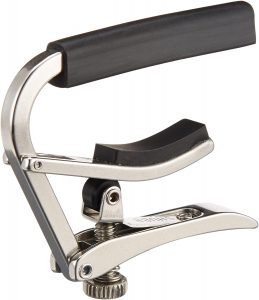
The Shubb S1 is our top pick for the best overall guitar capo because it combines adjustable tension, strong tuning stability and durable stainless-steel construction. It is especially good for steel-string acoustic guitar players who want a capo that does not pull the strings sharp as easily as many fixed-spring designs.
Best for:
- Acoustic guitar
- Electric guitar
- Tuning stability
- Players who want adjustable pressure
- Recording or live performance
Not ideal for:
- Players who need instant one-handed capo changes
- Some 12-string or wide-neck guitars
- Classical guitars, unless using a classical-specific model
Best Quick Change Capo: Kyser Quick-Change Capo
Our Rating: 9.4/10
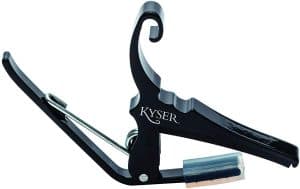
The Kyser Quick-Change Capo is one of the most popular guitar capos for a reason: it is fast, simple and easy to move with one hand. If you play live, lead worship, switch keys often, or just want a capo that is easy to use, the Kyser is a strong choice.
To use it, you squeeze the handle, place the capo just behind the fret, and release. When you are not using it, you can clip it to the headstock of your guitar.
The main downside is that the spring tension is not adjustable. On some guitars, especially guitars with lighter strings or lower action, this can pull the strings slightly sharp. On other guitars, it works perfectly fine.
For beginners, the Kyser is one of the easiest capos to recommend because there is almost no learning curve.
Product Details
- Spring-loaded quick-change design
- One-handed operation
- Aluminum body with steel spring
- Available in many colors
- Can be stored on the headstock when not in use
Pros:
- Very easy to use
- Great for beginners
- Excellent for quick key changes
- One-handed operation
- Many color options
- Made in the USA
Cons:
- Tension is not adjustable
- May pull some guitars slightly sharp
- Strong spring may be harder for some players to squeeze
- Can be placed crooked if moved too quickly
Who Should Buy the Kyser Quick-Change?
The Kyser Quick-Change is ideal for beginners, live performers and players who value speed over fine tension control. If you need the fastest capo to move during a set, this is one of the best choices. For more information check out our comparison of the Shubb and Kyser capos.
Best Premium Guitar Capo: G7th Performance 3 Capo
Our Rating: 9.0/10
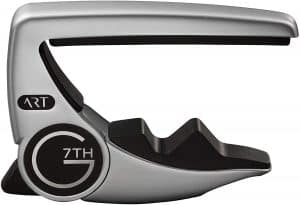
The G7th Performance 3 is a premium capo designed for players who want a sleek, low-profile design with strong tuning stability. It uses G7th’s Adaptive Radius Technology, which helps the capo match the curvature of your guitar’s fretboard.
This is useful because not every guitar has the same fretboard radius. If the capo does not match the neck well, some strings may buzz while others may be pressed too hard. The G7th Performance 3 is designed to apply more even pressure across the strings.
To use it, place it behind the fret and squeeze until the strings ring clearly. To release it, press the release mechanism. The design takes a little getting used to, but many players like how clean and unobtrusive it feels once it is on the neck.
The G7th is usually more expensive than basic capos, but it is a strong choice for players who want a more refined capo for acoustic or electric guitar.
Product Details
- Adaptive Radius Technology
- Squeeze-to-adjust tension
- Low-profile design
- Designed for steel-string acoustic and electric guitars
- Lifetime warranty from G7th
Pros:
- Sleek, modern design
- Good tuning stability
- Adaptive radius helps match different fretboards
- Low profile does not get in the way as much
- Easy tension adjustment
- Premium feel
Cons:
- More expensive than basic capos
- Release mechanism may take some getting used to
- May not work perfectly on every guitar/string setup
Who Should Buy the G7th Performance 3?
The G7th Performance 3 is a good choice for players who want a premium capo with a low-profile design and strong tuning stability. It is especially useful if you play both acoustic and electric guitar and want one capo that adapts well to different neck shapes.
Best Rolling Capo: Glider Capo by Greg Bennett
Our Rating: 8.8/10
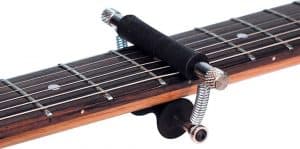
The Glider Capo is different from a standard guitar capo because it is designed to roll between frets. Instead of removing and re-clipping the capo every time you want to change position, you can roll it up or down the neck.
This makes it useful for players who want to change capo position during a song. It can also be stored behind the nut when not in use.
The Glider is not the best choice for every guitarist. It can be less simple than a standard capo, and moving it longer distances still requires some effort. However, for players who like the idea of shifting capo position without fully removing the capo, it is an interesting and useful option.
Product Details
- Rolling capo design
- Moves between frets
- Can store behind the nut
- Works on many acoustic and electric guitars
Pros:
- Can move between frets without removing the capo
- Useful for certain live or creative playing situations
- Can store behind the nut when not in use
- Does not require clipping and unclipping each time
Cons:
- Not as simple as a standard capo
- Does not always move as smoothly as expected
- Less ideal for beginners
- More of a specialty capo than an everyday capo
Who Should Buy the Glider Capo?
The Glider Capo is best for players who specifically want to move the capo during a song. If you only need a simple capo for changing keys, the Shubb or Kyser will likely be a better choice.
Best Capo for Alternate Tunings: Creative Tunings SpiderCapo
Our Rating: 8.7/10
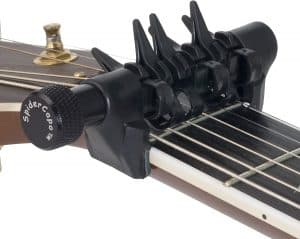
The SpiderCapo is a specialty capo designed for creative players, songwriters and guitarists who use alternate tunings. Unlike a standard capo, which presses all six strings at the same fret, the SpiderCapo lets you capo individual strings.
This means you can create open tuning-style sounds without fully retuning your guitar. For example, you can leave some strings open while fretting others with the capo. This creates new chord voicings and textures that are not possible with a normal capo.
The SpiderCapo is not the best option for beginners who simply want to change the key of a song. It takes more time to set up and is more complex than a standard capo. But for creative players, it can open up a lot of musical possibilities.
Product Details
- Individual string capo design
- Allows partial capo effects
- Useful for alternate tuning sounds
- Lightweight design
- Designed for creative and experimental playing
Pros:
- Great for alternate tunings
- Lets you capo individual strings
- Useful for songwriting and creative arrangements
- Can create open tuning sounds without retuning
- Lightweight design
Cons:
- Not as simple as a standard capo
- Not ideal for basic key changes
- Takes more time to set up
- Most beginners will not need this much flexibility
Who Should Buy the SpiderCapo?
The SpiderCapo is best for advanced players, songwriters and guitarists who want to experiment with alternate tunings and partial capo sounds. If you just need a normal capo, choose the Shubb, Kyser or G7th instead.
Best Guitar Capo by Use Case
Best Capo for Acoustic Guitar
For most steel-string acoustic players, the Shubb S1 is the best capo because it offers adjustable tension and reliable tuning stability. Acoustic guitars often need enough pressure to prevent buzzing, but too much pressure can pull notes sharp. The Shubb gives you more control than a fixed-spring capo.
The G7th Performance 3 is also a strong choice for acoustic guitar players who want a premium low-profile capo with adaptive pressure.
Best Capo for Electric Guitar
Electric guitars usually require less capo pressure than acoustic guitars because they often have lighter strings and lower action. For electric players, an adjustable capo like the Shubb S1 or G7th Performance 3 is usually better than a strong fixed-spring capo.
A Kyser can still work well on electric guitar, but the fixed spring tension may be stronger than necessary on some setups.
Best Capo for Beginners
The Kyser Quick-Change is one of the best capos for beginners because it is affordable, durable and easy to move with one hand. You do not need to adjust a screw or learn a special mechanism. Just squeeze, place and release.
The tradeoff is that the tension is not adjustable, so some guitars may need slight retuning after the capo is placed.
Best Capo for 12-String Guitar
Most standard 6-string capos do not work well on every 12-string guitar because 12-string necks are wider and require more even pressure. If you play 12-string guitar, look for a dedicated 12-string capo, such as a 12-string model from Shubb or another manufacturer.
Do not assume that a standard acoustic guitar capo will work perfectly on a 12-string guitar.
Best Capo for Classical Guitar
Classical guitars usually have wider, flatter fretboards than steel-string acoustic guitars. Most standard curved guitar capos are not ideal for classical guitar.
If you play classical guitar, choose a capo specifically designed for classical guitar. These capos usually have a flatter bar and wider reach to fit the neck properly.
Best Capo for Live Performance
For live performance, the Kyser Quick-Change is one of the best options because it can be moved quickly with one hand. If you need to change keys between songs or move the capo during a set, speed matters.
If tuning stability is more important than speed, the Shubb S1 is the better choice.
Best Capo for Recording
For recording, tuning stability is more important than speed. The Shubb S1 and G7th Performance 3 are better choices than most fixed-tension spring capos because they allow more controlled pressure across the strings.
When recording, even a slightly sharp string can become obvious, so use the least amount of capo pressure needed to get a clean sound.
How We Chose These Guitar Capos
We compared these capos based on the features that matter most to guitar players:
- Tuning stability
- Buzzing or muted strings
- Ease of use
- One-handed operation
- Build quality
- Fit on common acoustic and electric guitars
- Comfort while playing near the capo
- Value for the price
- Usefulness for different playing styles
We paid special attention to whether each capo pulled the strings sharp, whether it applied even pressure across all six strings, and how easy it was to move between frets.
Guitar Capo Buying Guide
Spring Capos vs Adjustable Capos
There are two common types of guitar capos: spring-loaded capos and adjustable capos.
A spring-loaded capo, like the Kyser Quick-Change, is fast and easy to use. You squeeze it open, place it behind the fret, and release. These are great for beginners and live players.
The downside is that the pressure is fixed. If the spring is too strong for your guitar, it may pull the strings sharp.
An adjustable capo, like the Shubb S1, lets you control the amount of pressure applied to the strings. This usually gives better tuning stability, but it can be slightly slower to place and move.
Fretboard Radius: Curved vs Flat Capos
Not all guitar necks have the same shape. Steel-string acoustic and electric guitars usually have a curved fretboard radius. Classical guitars usually have a flatter and wider fretboard.
This matters because a capo needs to press all strings evenly. If the capo does not match the fretboard shape, some strings may buzz while others are pressed too hard.
For most acoustic and electric guitars, choose a capo designed for steel-string guitars. For classical guitar, choose a classical-specific capo.
Tuning Stability and Intonation
One of the most common capo problems is tuning instability. If your guitar sounds out of tune after placing a capo, the problem is usually caused by one of these issues:
- The capo is applying too much pressure.
- The capo is too far behind the fret.
- The capo is crooked.
- The capo does not match the fretboard radius.
- The guitar’s intonation or setup needs adjustment.
Adjustable capos usually help because you can use only the amount of pressure needed.
Neck Width and Guitar Type
Before buying a capo, make sure it fits your guitar type.
| Guitar Type | Recommended Capo |
| Steel-string acoustic | Curved steel-string capo |
| Electric guitar | Adjustable or lighter-tension capo |
| Classical guitar | Flat/wide classical capo |
| 12-string guitar | Dedicated 12-string capo |
| Ukulele | Ukulele capo, not a standard guitar capo |
Classical guitars and 12-string guitars often require special capos because of their wider necks.
Capo Placement
Proper capo placement makes a big difference.
For the cleanest tone, place the capo just behind the fret, not in the middle of the fret space. The capo should be straight and parallel to the fret.
Avoid these common mistakes:
- Placing the capo too far back from the fret
- Using too much pressure
- Letting the capo sit diagonally
- Using the wrong capo for your guitar type
- Forgetting to check tuning after placing the capo
A properly placed capo should make every string ring clearly without pulling the guitar noticeably out of tune. For more details look at our guide to “Why Does My Capo Make My Guitar Go Sharp?”.
Common Capo Mistakes
Placing the Capo Too Far from the Fret
If the capo is too far back, the strings may buzz or sound weak. Place it close to the fret for a cleaner tone.
Using Too Much Pressure
More pressure is not always better. Too much pressure can pull strings sharp. Adjustable capos help solve this problem.
Using the Wrong Capo for the Guitar
A standard curved capo may not work well on a classical guitar. A normal 6-string capo may not fit every 12-string guitar. Match the capo to the instrument.
Not Checking Tuning
Even with a good capo, you may need to check tuning after placing it, especially when recording or performing.
Placing the Capo Crooked
A capo should sit straight across the fretboard. If it is angled, some strings may be sharper or duller than others.
Alternatives to a Standard Capo
Most players will be happy with a standard full capo, but there are other options.
Partial Capos
Partial capos only cover some of the strings. They are useful for creating open tuning-style sounds without retuning the guitar.
Popular examples include:
Partial capos are especially useful for songwriters and players who want to experiment with new chord voicings.
Rolling Capos
A rolling capo, like the Glider Capo, lets you move the capo between frets without fully removing it. This can be useful if you need to shift position during a song.
Individual String Capos
The SpiderCapo lets you capo individual strings. This is the most flexible option for alternate tunings, but it is also more complex than a standard capo.
Shubb vs Kyser vs G7th: Which Capo Should You Choose?
Choose the Shubb S1 if…
You want the best overall capo for tuning stability, adjustable pressure and regular use. The Shubb is especially good for acoustic guitar players and anyone who dislikes retuning after using a capo.
Choose the Kyser Quick-Change if…
You want the fastest and easiest capo to move. The Kyser is great for beginners, live performers and players who need quick one-handed changes.
Choose the G7th Performance 3 if…
You want a premium capo with a sleek design, low profile and adaptive pressure. The G7th is a strong choice for players who use multiple guitars and want a refined capo.
Frequently Asked Questions About Guitar Capos
What is the best guitar capo?
For most players, the Shubb S1 is the best overall guitar capo because it offers adjustable tension, strong tuning stability and durable construction. Players who need fast one-handed changes may prefer the Kyser Quick-Change.
What is the best capo for acoustic guitar?
The Shubb S1 is our top choice for acoustic guitar because it gives you adjustable pressure and reliable tuning stability. The G7th Performance 3 is another excellent premium option.
What is the best capo for electric guitar?
For electric guitar, an adjustable capo is usually best because electric guitars often use lighter strings and lower action. The Shubb S1 and G7th Performance 3 are both good options.
What is the best capo for beginners?
The Kyser Quick-Change is one of the best beginner capos because it is simple, durable and easy to move with one hand.
Why does my guitar go out of tune when I use a capo?
A guitar usually goes out of tune with a capo because the capo applies too much pressure, is placed too far from the fret, or does not match the guitar’s fretboard radius.
Can I use the same capo for acoustic and electric guitar?
Yes, many capos work on both acoustic and electric guitar. However, an adjustable capo may work better across different guitars because you can control the amount of pressure.
Do classical guitars need a special capo?
Yes. Classical guitars usually have wider, flatter fretboards, so they need a capo designed specifically for classical guitar.
Do 12-string guitars need a special capo?
Often, yes. A 12-string guitar usually needs a capo with enough width and pressure to cover all twelve strings evenly. A standard 6-string capo may not work well.
Where should I place a capo?
Place the capo just behind the fret, not in the middle of the fret space. It should be straight and parallel to the fret.
Are expensive capos worth it?
Expensive capos can be worth it if you care about tuning stability, build quality and a lower-profile design. Beginners may be perfectly happy with a more affordable quick-change capo.
Final Verdict: What Is the Best Guitar Capo?
For most players, the Shubb S1 is the best overall guitar capo. It offers adjustable tension, dependable tuning stability and durable stainless steel construction. It is especially good for steel-string acoustic players who want a capo that applies even pressure without pulling the strings sharp.
The Kyser Quick-Change is a better choice if speed matters most. It is easy to move with one hand and works well for live performance, worship music and quick key changes. However, because the tension is not adjustable, it may require slight retuning on some guitars.
The G7th Performance 3 is the best premium option if you want a sleek capo with adaptive pressure and a low-profile design.
The Glider Capo and SpiderCapo are more specialized choices. The Glider is useful if you want to move the capo while playing, while the SpiderCapo is best for alternate tunings and creative arrangements.
Shubb S1 Guitar Capo
Why we recommend it:
It offers the best balance of tuning stability, build quality, adjustability and everyday usability.
Recap: Best Guitar Capos
| Rank | Capo | Best For |
| 1 | Shubb S1 | Best overall guitar capo |
| 2 | Kyser Quick-Change | Best quick change capo |
| 3 | G7th Performance 3 | Best premium capo |
| 4 | Glider Capo | Best rolling capo |
| 5 | Spider Capo | Best capo for alternate tunings |