If you are trying to decide between a Shubb capo and a Kyser capo, you are not alone. These are two of the most popular guitar capos for acoustic and electric guitar players, but they work very differently.
The biggest difference comes down to speed versus adjustability.
The Kyser Quick-Change capo is designed for fast one-handed movement, making it popular for live performance, worship guitar, and beginners. The Shubb S1 capo uses an adjustable tension system that gives you more control over pressure, tuning stability, and intonation.
Neither capo is objectively better for every player. The best choice depends on your playing style, how often you move the capo, what type of guitar you play, and how important tuning stability is to you.
If you want to compare these against other top-rated options, see our full guide to the best guitar capos for acoustic, electric, and beginner guitarists.
Table of Contents
Quick Verdict: Shubb vs Kyser
Choose the Shubb S1 if you want better tuning stability, adjustable pressure, and a more precise capo for recording or electric guitar.
Choose the Kyser Quick-Change if you want the fastest, easiest capo for live performance, worship music, or beginner guitar playing.
| Category | Winner |
|---|---|
| Best Overall for Tuning Stability | Shubb S1 |
| Best for Beginners | Kyser Quick-Change |
| Best for Live Performance | Kyser Quick-Change |
| Best for Recording | Shubb S1 |
| Best for Electric Guitar | Shubb S1 |
| Best for Acoustic Guitar | Tie / Depends on Use |
| Fastest to Move | Kyser Quick-Change |
| Most Adjustable | Shubb S1 |
Quick Comparison: Shubb S1 vs Kyser Quick-Change
| Feature | Shubb S1 | Kyser Quick-Change |
|---|---|---|
| Capo Type | Adjustable clamp | Spring-loaded |
| Best For | Tuning stability | Fast changes |
| One-Handed Use | Moderate | Excellent |
| Tension Adjustment | Yes | No |
| Live Performance | Good | Excellent |
| Recording | Excellent | Good |
| Beginner Friendly | Moderate | Excellent |
| Acoustic Guitar | Excellent | Excellent |
| Electric Guitar | Excellent | Good |
| Speed | Slower | Very fast |
| Price Range | Moderate | Moderate |
How We Compared the Shubb and Kyser Capos
To compare the Shubb S1 and Kyser Quick-Change, we looked at the factors that matter most to everyday guitar players:
- Tuning stability
- Ease of use
- Speed of capo changes
- Acoustic guitar performance
- Electric guitar performance
- Beginner friendliness
- Live performance usefulness
- Recording accuracy
- Overall value
Both capos are high-quality options, but they solve different problems. The Shubb is built for control and precision, while the Kyser is built for speed and convenience.
Shubb S1 Overview
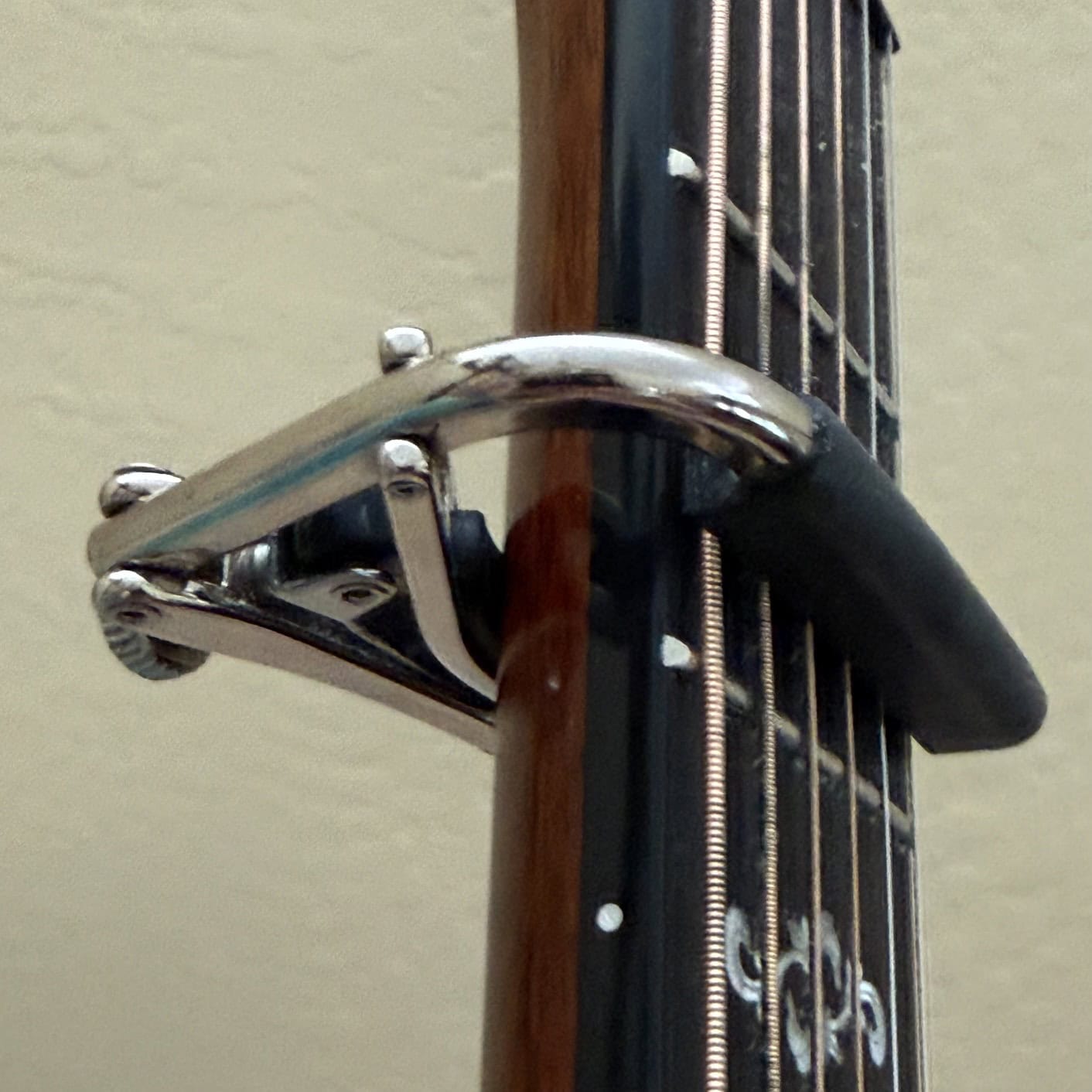
The Shubb S1 is one of the most respected adjustable guitar capos available. Instead of using a fixed spring, the Shubb uses a screw adjustment system that lets you control the amount of pressure placed on the strings.
This is important because too much pressure can pull strings sharp and cause tuning problems. By using only the amount of pressure needed, the Shubb often provides better tuning stability than many spring-loaded capos.
The tradeoff is speed. The Shubb is not as fast to move during a song as a Kyser, especially if you need quick key changes on stage.
Best For
The Shubb S1 is best for:
- Acoustic guitar players who care about tuning stability
- Recording musicians
- Players sensitive to intonation issues
- Electric guitar players with lighter strings
- Guitarists who want adjustable pressure
- Players who prefer precision over speed
Potential Downsides
The main downsides of the Shubb S1 are:
- Slower than spring-loaded capos
- Slight learning curve
- Not as convenient for fast live changes
- Requires pressure adjustment for best results
Kyser Quick-Change Overview
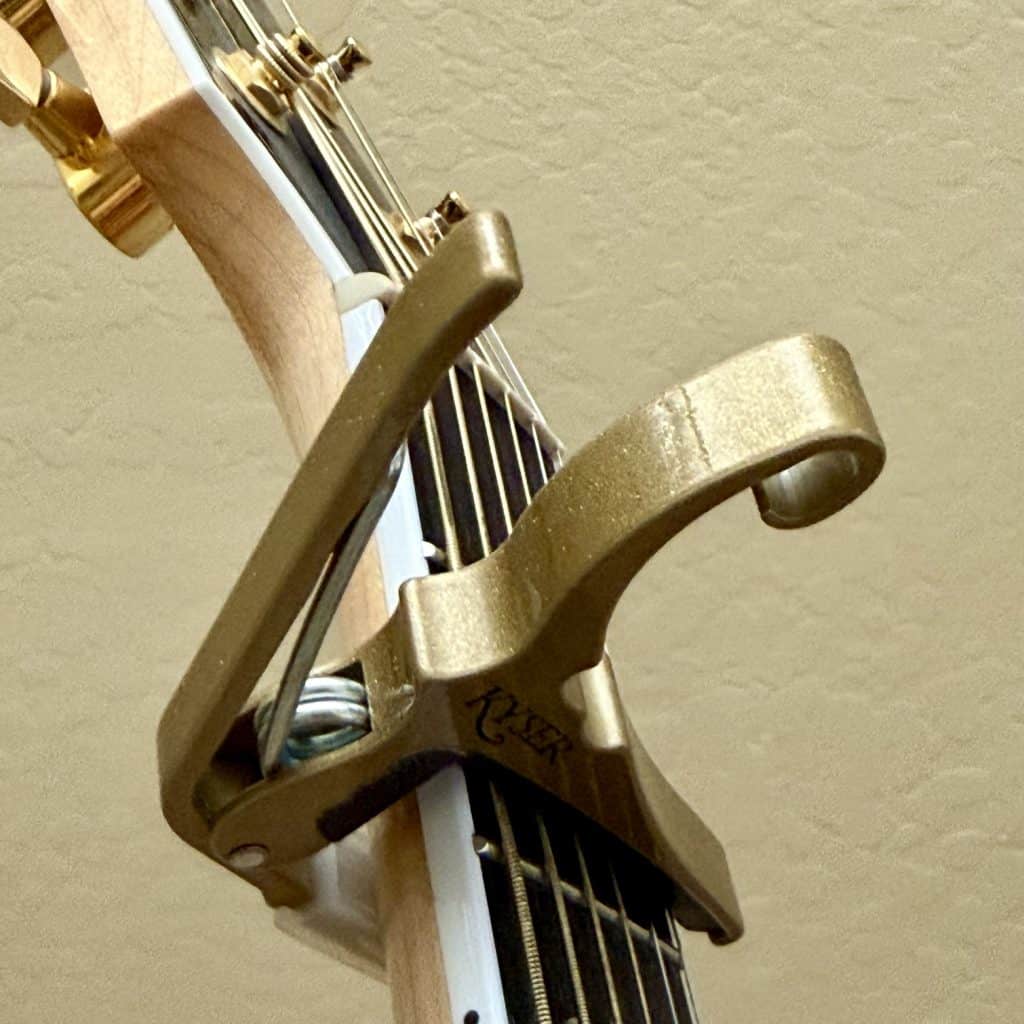
he Kyser Quick-Change capo is one of the most popular spring-loaded capos ever made. It is especially common among live performers, worship guitarists, and beginners because it can be moved quickly with one hand.
To use it, you simply:
- Squeeze the handle
- Place it behind the fret
- Release
The biggest advantage of the Kyser is speed and convenience. You can reposition it in seconds during a performance, making it a favorite for players who change keys often.
The downside is that the spring tension is fixed. On some guitars, especially lower-action electric guitars, the pressure may be stronger than necessary and can slightly pull strings sharp.
Best For
The Kyser Quick-Change is best for:
- Live performance
- Worship guitar
- Beginners
- Quick key changes
- Acoustic guitar players
- Players who prioritize convenience
- One-handed capo changes
Potential Downsides
The main downsides of the Kyser are:
- No tension adjustment
- Can pull some guitars slightly sharp
- Strong spring may feel excessive on some setups
- Less precise than adjustable capos for recording
Tuning Stability: Which Capo Performs Better?
For tuning stability, the Shubb S1 usually performs better.
Because the tension is adjustable, you can dial in only the amount of pressure needed to get clean notes without over-compressing the strings. This helps reduce the chance of pulling strings sharp.
The Kyser uses fixed spring tension. On many acoustic guitars, this works perfectly well. However, on some electric guitars or low-action setups, the spring pressure may be stronger than necessary.
If you record frequently, play with lighter strings, or are very sensitive to intonation, the Shubb is usually the better choice.
Winner for tuning stability: Shubb S1
Ease of Use and Speed
This is where the Kyser Quick-Change shines.
The Kyser is one of the fastest capos available. Many live guitarists prefer it because it can be moved with one hand in seconds.
The Shubb is still easy to use, but it takes longer because the latch and pressure adjustment require more precision. Once it is adjusted correctly, it works very well, but it is not as fast for mid-song capo changes.
If speed matters most, the Kyser wins.
Winner for ease of use and speed: Kyser Quick-Change
Shubb vs Kyser for Acoustic Guitar
Both capos work well on acoustic guitar, but they appeal to different types of players.
Choose the Shubb S1 for acoustic guitar if:
- Tuning stability matters most
- You record often
- You dislike retuning after capo changes
- You want more control over string pressure
- You play fingerstyle or more precise arrangements
Choose the Kyser Quick-Change for acoustic guitar if:
- You perform live
- You move the capo frequently
- You play worship, folk, country, or singer-songwriter music
- Convenience matters more than fine adjustment
- You want quick one-handed changes
For most acoustic players, either capo can work well. The better choice depends on whether you value precision or speed.
Winner for acoustic guitar: Tie, depending on use
Shubb vs Kyser for Electric Guitar
Electric guitars often use lighter strings and lower action, which means excessive capo pressure becomes more noticeable.
Because of this, the Shubb S1 is often the better choice for electric guitar players. The adjustable pressure helps avoid pulling strings sharp, especially on guitars with lighter gauge strings or sensitive intonation.
A Kyser can still work on electric guitar, but some setups may require slight retuning after placement. The fixed spring tension can sometimes press harder than needed, especially on lower-action guitars.
If you mostly play electric guitar and care about staying in tune, the Shubb is usually the safer choice.
Winner for electric guitar: Shubb S1
Which Capo Is Better for Beginners?
For beginners, the Kyser Quick-Change is usually easier.
There is almost no learning curve. You squeeze, place, and release. That makes it one of the most beginner-friendly capos available. Check our Capo chart on how to use your capo to convert a difficult song to open chords.
The Shubb takes slightly more adjustment and setup knowledge. It is not difficult to use, but beginners may need to experiment with the tension screw to get the best results.
However, beginners who care about tuning stability may still prefer the Shubb long term.
Winner for beginners: Kyser Quick-Change
If you want to compare more beginner-friendly options, see our roundup of the best guitar capos for acoustic and electric guitar.
Which Capo Is Better for Live Performance?
For live performance, many players prefer the Kyser Quick-Change because of its speed.
If you need:
- Quick key changes
- Fast repositioning
- One-handed operation
- Simple use on stage
- A capo you can move between songs quickly
…the Kyser is hard to beat.
The Shubb can still work well live, especially if you do not need to move your capo often. But for fast stage use, the Kyser is usually more convenient.
Winner for live performance: Kyser Quick-Change
Which Capo Is Better for Recording?
For recording, the Shubb S1 is usually the better choice.
In a recording setting, tuning stability and clean intonation matter more than speed. The Shubb’s adjustable tension lets you apply just enough pressure to get clear notes without forcing the strings sharp.
This can save time in the studio and reduce the need to retune after every capo placement.
The Kyser can still be used for recording, especially on guitars where the spring tension works well. But if you want the most control, the Shubb has the advantage.
Winner for recording: Shubb S1
Capo Placement Matters
No matter which capo you choose, placement makes a big difference.
Both the Shubb and Kyser usually perform best when placed just behind the fret, not in the middle of the fret space. Placing the capo too far back can cause buzzing, while placing it directly on top of the fret can affect tone and feel.
Some tuning issues blamed on the capo are actually caused by poor placement.
For best results:
- Place the capo close behind the fret
- Use only enough pressure to make the notes ring clearly
- Retune if needed after placing the capo
- Avoid clamping too hard
- Make sure all strings are pressed evenly
This is especially important on electric guitars, low-action guitars, and guitars with lighter strings.
Neck Shape, String Gauge, and Setup Matter
Your results may vary depending on your guitar.
A capo that works perfectly on one guitar may feel too tight, too loose, or slightly awkward on another. Important factors include:
- Neck profile
- Fretboard radius
- String gauge
- String height/action
- Fret size
- Acoustic vs electric setup
This is one reason adjustable capos like the Shubb can be useful. They allow you to fine-tune the pressure for different guitars.
However, if your guitar works well with the Kyser’s spring tension, the convenience may be worth it.
Who Should Buy the Shubb S1?
You should choose the Shubb S1 if you:
- Want better tuning stability
- Care about intonation
- Record often
- Play electric guitar
- Use lighter strings
- Prefer adjustable pressure
- Do not need the fastest capo changes
- Want a more precise capo
The Shubb is the better choice for players who want control and accuracy.
Who Should Buy the Kyser Quick-Change?
You should choose the Kyser Quick-Change if you:
- Want the fastest capo movement
- Play live often
- Need one-handed operation
- Are a beginner
- Play worship music
- Change keys frequently
- Want a simple squeeze-and-release design
- Prefer convenience over adjustment
The Kyser is the better choice for players who want speed and simplicity.
Final Verdict: Shubb vs Kyser
Both the Shubb S1 and Kyser Quick-Change are excellent guitar capos, but they are built for different priorities.
Choose the Shubb S1 if you want:
- Better tuning stability
- Adjustable pressure
- Improved intonation
- A capo for recording
- A better option for electric guitar
- More control over string pressure
Choose the Kyser Quick-Change if you want:
- The fastest capo movement
- Simple one-handed operation
- A beginner-friendly capo
- Convenience during live performance
- Quick key changes
- An easy capo for acoustic guitar
The Shubb is usually better for precision. The Kyser is usually better for speed.
If you want to compare these two capos with other popular models, see our complete guide to the best guitar capos for acoustic, electric, and beginner guitarists.
FAQ: Shubb vs Kyser Capos
Is Shubb better than Kyser?
The Shubb is better for tuning stability, adjustable pressure, and recording. The Kyser is better for speed, one-handed use, and beginner-friendly convenience.
Is the Kyser capo good for beginners?
Yes. The Kyser Quick-Change is one of the easiest capos for beginners because it uses a simple squeeze-and-release design.
Does a Kyser capo pull strings sharp?
It can on some guitars. This is more likely on electric guitars with lighter strings or low action because the Kyser uses fixed spring tension.
Is the Shubb capo good for electric guitar?
Yes. The Shubb S1 is a strong option for electric guitar because the adjustable tension helps avoid pulling strings sharp.
Which capo is better for acoustic guitar?
Both work well on acoustic guitar. Choose the Kyser if you want fast, easy changes. Choose the Shubb if you care more about tuning stability and pressure control.
Which capo is better for live performance?
The Kyser Quick-Change is usually better for live performance because it is faster and easier to move with one hand.
Which capo is better for recording?
The Shubb S1 is usually better for recording because the adjustable pressure helps improve tuning stability and intonation.